
Parkersburg Previous-Resident Sources
A backward address trail needs sources that cover different eras and roles. Wood County deeds provide the ownership spine. Parkersburg directories can add dated occupants, including people who may not own the property. Census schedules show households at federal census intervals, while maps test whether the structure or street label existed. Permit coverage is less direct because no public historical permit index was located. For a precise building question, submit a dated address request to the city or county office with jurisdiction.
| Source | Years It Covers | Where Held | What It Shows |
|---|---|---|---|
| Deed and lien books | 1799-present | Wood County Clerk, portal and Room 103 | Transfer parties, dates, legal descriptions, book/page |
| Parkersburg directories | Points from 1878; exact WVU runs 1925-1985 | WVU microfilm, Parkwood requests | Dated names and addresses; fields vary by volume |
| Federal census | Public schedules through 1950 | NARA and library databases | Household members and enumeration context |
| Sanborn maps | 1893 and 1916 | Library of Congress | Historic footprint, use, and street label |
| Probate and obituaries | Varies by source | County probate, Parkwood, Kothe archive | Heirs, relatives, death notice, transfer context |
Start with the assessor and latest deed for a modern question. Use the nearest city-directory year when the target falls in the twentieth century. For an earlier Parkersburg property, let the legal description lead through the deed books, then compare maps, newspapers, probate, and the surviving directory references. An absence online is not proof that no record exists.
Start Parkersburg House History Today
The current Wood County parcel record supplies the bridge into older material. Search the CAMA parcel address and save the assessed owner, mailing address, district-map-parcel, account number, legal description, and deed book/page. Keep the situs, or physical property address, separate from the tax mailing address. A different mailing city may show where correspondence goes, not where the assessed owner lives.
The Card File offers Address mode and returns District, Map, Parcel, Name One, Name Two, Owner, Address, Book-Page, and Description. It can help when CAMA wording is hard to match, though the county warns of a one-day replication delay. These current records are starting points, not proof of every past resident.
The official Card File screen shows the address-based route into a Parkersburg house-history search.
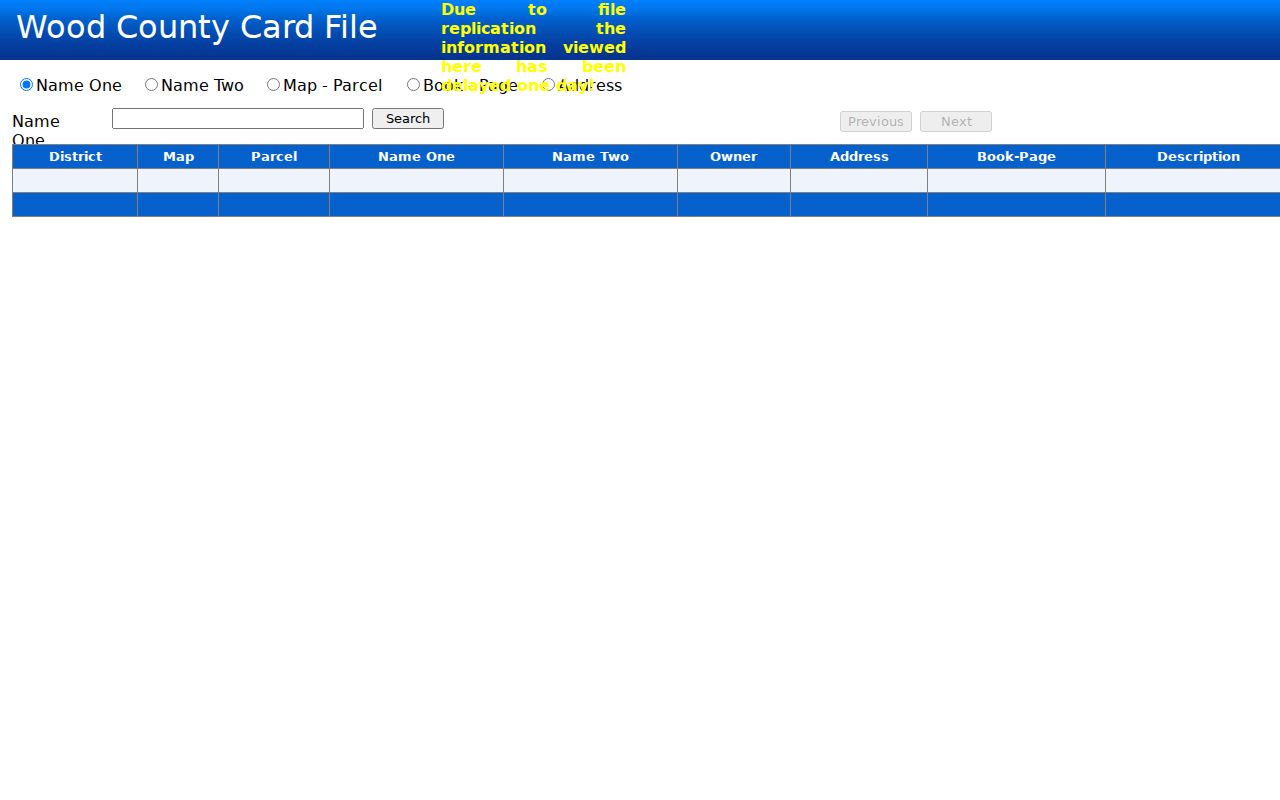
The result fields connect a modern street line to the parcel and recorded deed reference needed for the backward chain.
Trace Wood County Owners Backward
The Wood County Clerk keeps deed and lien books from 1799 to the present. Online Document Inquiry can show parties and scanned originals when available, but the clerk does not state an exact online start year and does not perform title searches. A past-household project can document a likely ownership trail. It cannot certify title.
- Copy the current owner's name, legal description, parcel key, and deed book/page from CAMA or the Card File.
- Open Wood County Document Inquiry and locate the purchase deed. Record its date, grantor, grantee, book/page, legal description, and all named parties.
- Search the seller, now as a prior buyer or grantee. Use date and document-type filters and inspect the People icon for associated parties.
- Repeat the seller-as-earlier-grantee loop. Match legal wording and parcel clues rather than relying on the street number alone.
- When the online image or index ends, request the deed book copy from the clerk's first-floor record room.
- Grantor / grantee
- The grantor transfers an interest; the grantee receives it.
- Chain of title
- The linked sequence of recorded transfers for the same land.
- Legal description
- The lot, block, subdivision, or boundary wording that identifies land even when its street address changes.
Copies cost $1.50 for the first two pages and $1 for each additional page. The clerk's described certified-mail route calls for identification, a self-addressed stamped envelope, and a money order or certified check. Personal checks are not accepted for that request.
Keep Parkersburg Parcel Keys
No verified Parkersburg-wide street-renumbering year was found. A gap between an old directory address and a modern parcel must therefore be bridged, not explained with an assumed date. Preserve the legal description, cross street, subdivision, lot and block, and district-map-parcel. Historic maps from 1873, an 1886 Wood County atlas, and a 1901 city atlas may help align the old label.
Wood County's private-drive rules add another local issue. Shared drives may be named, and structures can be readdressed by distance with even and odd sides. Existing structures may receive a new number after the drive name is adopted. This is why a prior resident search that saves only the typed street line can break. The parcel and deed wording tend to survive the change.
Note: A county parcel map is a best-fit assessment aid, not a survey or a legal boundary determination.
Two Parkersburg Map Snapshots
The Library of Congress Sanborn sets offer two concrete Parkersburg checkpoints: June 1893 has 14 sheets, and February 1916 has 40 sheets including North Parkersburg. A sheet can reveal a period structure footprint, use, or street label. It cannot identify a present owner or replace a modern survey. Treat the map as one layer in a chain.
For a strong comparison, start with the historic footprint, align it to the present GIS parcel, pull CAMA's assessed owner and legal description, follow the deed book/page backward, and then search a nearby directory year for an occupant. Each source has a different keeper and a different level of certainty. Agreement among them is far more useful than a name found in only one index.
Pair Parkersburg Directories and Census
Directory volumes can fill the long spaces between public federal census schedules. WVU lists Parkersburg microfilm runs for 1925-1953, 1954 through July 1964, 1965-1974, 1975-1981, and 1982-1985. Earlier official references identify 1878, 1898, 1907, 1912, 1919, and 1930. Availability of a cited year does not guarantee a reverse, street-arranged section, so request the exact year and directory type.
- Choose the directory year nearest the deed transfer or known family date.
- Record the entry exactly, including spelling, address, spouse or relative, occupation, and owner or renter mark only when printed.
- Repeat in the next available volume and keep each change rather than smoothing it away.
- Pair the address with the nearest released census schedule and its enumeration district, the local area a census taker covered.
- Use deeds, newspapers, probate, and maps to explain gaps between the two timelines.
NARA's directory guide identifies Parkersburg and Belpre references for 1930 and 1932. Census schedules follow the federal 72-year release rule. The complete shelf and publisher history belongs to the Parkersburg directory-book resource; the task here is using selected years to identify who lived here before.
Parkersburg Families Beyond Online Indexes
The Phelps-Tavenner Research Center is the strongest local fallback when past residents disappear from web results. Its Wood County Historical and Preservation Society holdings include maps, photographs, scrapbooks, local files, cemetery records, and yearbooks. The center reports family-history information on more than 450 families. Those materials can connect a street name, school photo, cemetery entry, or family file with the address trail.
The center at 2401 Camden Avenue is open Wednesday from 9 a.m. to 1 p.m. and Saturday from 1 to 4 p.m., with appointments available. Parkwood Library also offers remote genealogy research. Its posted terms include a $2 minimum request, ten cents per page, no more than five requests, and at least a month and year for newspaper work.
The Phelps-Tavenner House research page introduces this Parkersburg family-history collection.
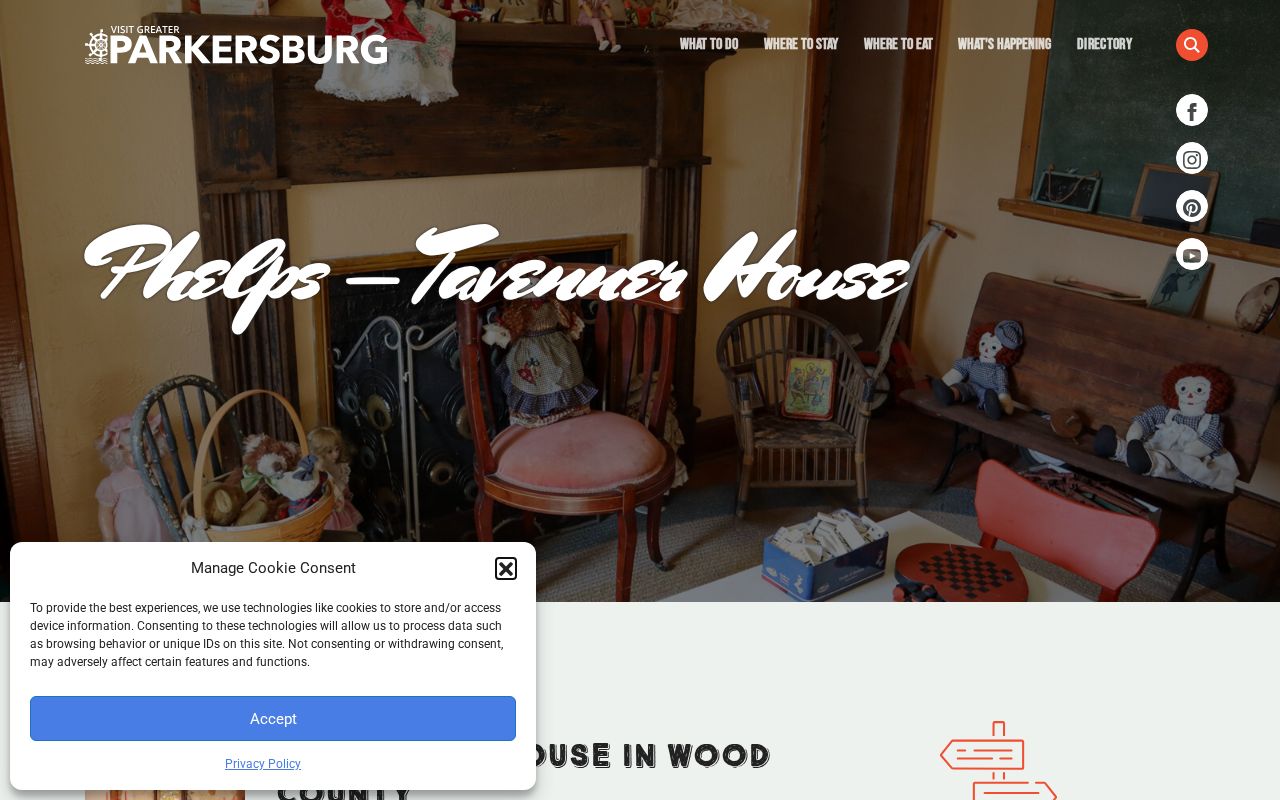
The local files and yearbooks can supply human links that a parcel or deed index was never designed to preserve.
Parkersburg Records Still Being Scanned
A July 2025 local report described deterioration and water-damage concerns in the former Sheriff's office, along with circuit-clerk scanning of old material and books said to reach back to 1810. That account explains why courthouse and online results may differ. It does not mean every old volume is digitized or searchable from home.
The practical response is to date every portal search and ask the custodian whether the missing item is a scanned book, a physical volume, an offsite record, or a restricted image. Wood County land books are stated as 1945 to the present with older books offsite. Deed books reach farther back, but the clerk publishes no imaging cutover.
The 2025 records-storage report documents the preservation and scanning context.
The report supports a dual search route: use the portal first, then confirm gaps with the office that holds the original material.
Close a Parkersburg Household Trail
Owners are only half of a house history. A directory entry may identify an occupant, while a census schedule can place related household members together. An obituary may link a former address to relatives, a cemetery, or a later community. Parkwood's newspaper request service and the Kothe Memorial archive are local routes. The latter spans Parkersburg Eclipse pages from 1872-1969 and Eclipse News Review pages from 1969-2023. Check OCR against the page image because old type and street abbreviations are easily misread.
Probate can explain a deed that moves through an estate or heirs. Wood County administers an estate where the person lived, and the probate office keeps inventories, appraisements, settlements, and related papers. FamilySearch catalogs Wood County wills for 1791-1859 and chancery orders for 1831-1926, though account or image limits may apply. When a deceased owner vanishes from the deed trail, search the probate name and obituary date before assuming an ordinary sale.
Lawful use. Research previous residents for Parkersburg house history, genealogy, estate work, or personal curiosity. Do not use any finding to track, harass, intimidate, or harm a living person.